Home/Insights/Blogs/Real Talk with Bob Wright: The operational backbone of sovereign data centres
Real Talk with Bob Wright: The operational backbone of sovereign data centres
Blog
Bob Wright
5min read
In our Real Talk series, we spotlight leaders who shape how sovereignty, infrastructure and operations work in the real world.
The operational backbone of sovereign infrastructure
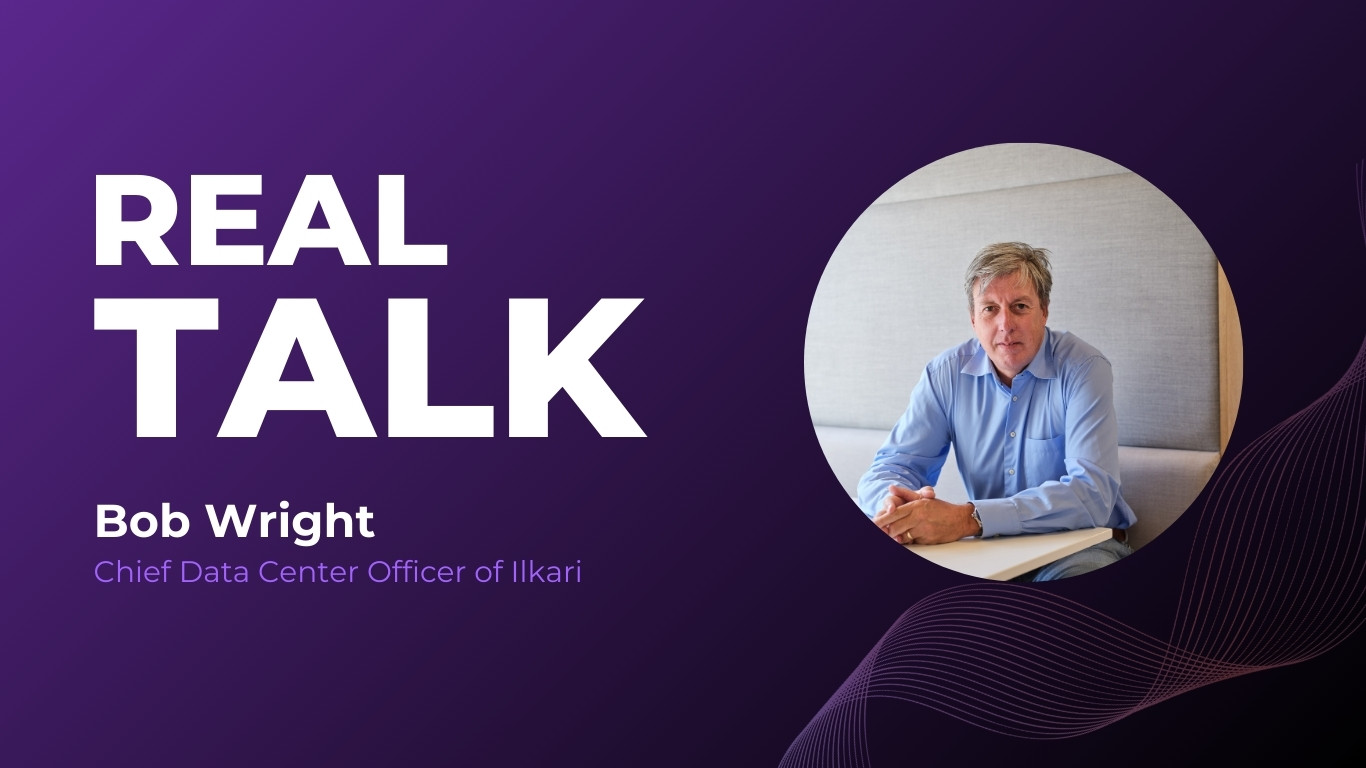
We closed 2025 with our Head of Data Centre Colombia, Eduardo Espinel’s perspective on collaboration and ecosystem growth. To kick off 2026, we turn to Bob Wright, Ilkari’s Chief Data Centre Officer, whose four decades in telecom networks and data-centre operations have given him a front-row seat to the evolution of infrastructure.
Bob’s perspective on operations is grounded in engineering discipline, a relentless commitment to doing the unseen work well and the belief that real sovereignty is earned, not claimed.
An engineer who never stopped being an engineer
Bob began with design and stayed close to the systems ever since. His grounding in telecom networks and data centres shaped a view of operations that is both technical and deeply practical.
Anyone can build infrastructure. The real test is whether you can diagnose and repair it when something goes wrong.
Bob Wright, Chief Data Centre Officer at Ilkari
Operations, to him, are the backbone of any technology service. When things go right, no one notices. When things go wrong, operations are the first to respond. That cycle — invisible success, visible responsibility — is what shaped his approach to preparedness, measurement and continuous learning.
What DCOS Level 4 actually validates
With Ilkari now holding DCOS Maturity Level 4, ICREA Level IV,TIA-942-C Rated 3 and SS 564 Sustainable Data Centre, Bob explains what these certifications confirm from an operational standpoint.
DCOS Level 3 showed that the organisation understood how to operate at a high standard. Level 4 requires proof in live conditions. An external auditor must review how the facility performs day to day, not just on paper.
Obtaining DCOS Level 4 ensures that an external party has validated how we have operated the data centre with live operations.
Bob Wright, Chief Data Centre Officer at Ilkari
The real misconceptions behind being “AI-ready”
As artificial intelligence (AI) workloads accelerate, Bob sees recurring misconceptions across discussions with customers and providers:
Power density is often overstated Organisations frequently design for the theoretical maximum, but real utilisation is almost always lower. Without accurate modelling, both costs and designs drift away from actual need.
Cooling technologies are assumed to be interchangeable Chilled water, liquid cooling and immersion systems operate with different design requirements, maintenance expectations and cost structures. Choosing based on trends rather than load realities leads to long-term operational challenges.
Rigid designs limit future capacity AI workloads shift quickly. Facilities that lack flexibility — in layout, cooling, or power distribution — struggle to adapt to those shifts.
Bob sees AI readiness as a discipline of matching real load behaviour with intentional design, not a feature that can be applied broadly across a facility.
Where sovereignty succeeds or fails: the invisible layer
Bob brings sovereignty down to its most practical layer — the systems that monitor, measure and maintain the health of the data centre. It is not a concept; it is a set of behaviours.
If you aren’t measuring it continuously, you aren’t controlling it.
Bob Wright, Chief Data Centre Officer at Ilkari
For Bob, sovereignty is determined by:
The KPIs and OKRs that define expected performance
Preventative maintenance schedules
The data that exposes drift before downtime
The 24x7x365 monitoring that ensures the operation is behaving as intended
These internal systems are what make sovereignty real, not theoretical.
How to tell sovereign cloud from sovereign washing
Bob is direct: many providers use the term “sovereign cloud” without owning or operating the infrastructure behind the claim.
His guidance to customers is straightforward — follow the control path. Who owns the racks? Who owns the data centre? Who runs the cloud platform? Who employs the team responsible for operations?
“Your data belongs to you, and only you should control who has access to that data, no one else.”
If any part of that chain is outsourced or disconnected, sovereignty is weakened.
Operational principles that do not bend
Ilkari’s operational philosophy, led by Bob, prioritises:
Preventing issues where possible
Fixing issues quickly when they occur
Never assuming component reliability
Maintaining supplier readiness
Verifying system outputs as part of the daily routine
Bob notes that even brief outages can cause revenue loss, customer impact and reputational damage. The team’s role is to minimise that exposure.
Redefining the data centre
Bob has watched the industry shift from early colocation to today’s mix of AI factories, high-density compute and emerging edge infrastructure. He sees AI driving the need for more standardised design blueprints and a broader hub-and-spoke model across global regions.Not every market can support a 10 KW facility, but every market requires access to the same capabilities. That tension — between global demand and regional capacity — mirrors the network expansion patterns of earlier decades.
All of the above will still need to ensure data sovereignty standards are demonstrable.
Bob Wright, Chief Data Centre Officer at Ilkari
Standing out when every provider claims the same things
When asked what differentiates Ilkari in a market where nearly every provider now claims sovereignty, sustainability or AI readiness, Bob returns to structure. Ilkari owns and operates the entire stack: the data centres, the racks, the cloud platform and the teams who run it. There is no separation between the infrastructure and the people maintaining it.
He also points to Ilkari’s externally certified sustainability practices through SS 564, and the flexibility of its designs, which support deployments from 10kW to more than 200kW without locking customers into fixed layouts.
Much of the differentiation, he says, comes from how the team operates every day: preventative maintenance, rigorous monitoring, supplier readiness and the discipline to confirm system behaviour long before issues surface.
It is the accumulation of these operational choices that shapes how Ilkari performs and how customers experience the service.